by Jim Kiker
Scale: 1/48
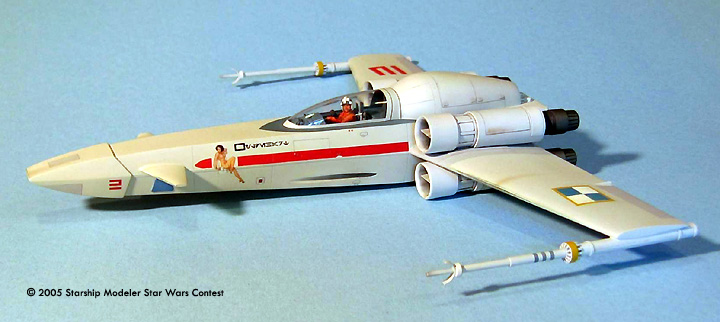
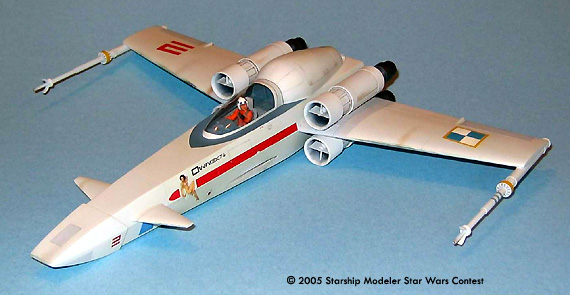
The Headhunter FR 17 was developed as a new Fleet multi-role fighter for the Self Defense Forces of Solaris III. The new fighter needed to be capable of extended operations in atmosphere as well as space, and be capable of limited hyperspace jumps. The new design was based on Z-95 Headhunter II technology. The wings were extended, tapered, swept back, and given an airfoil cross-section; small canards were added on the forward fuselage. FR 17's are powered by four Incom 2A-E (Enhanced) engines, giving the FR 17 nearly 40% more power and a significantly higher top speed.
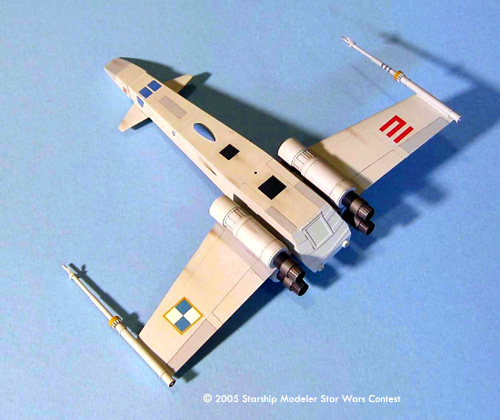
The reconnaissance equipment includes four planar imaging arrays, one on each side of the fuselage under the canards and two arrays on the forward lower fuselage. When coupled together, these arrays provide horizon-to-horizon scanning, while the two lower arrays can also be set to provide full stereoscopic imagery below the craft. An integrated infrared sensor oriented to scan below the vehicle completes the sensor suite.
Construction
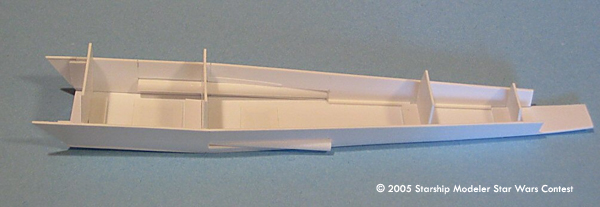
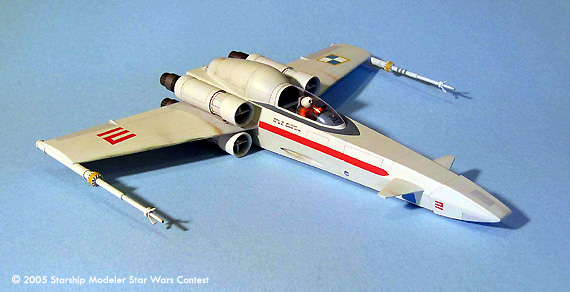
Fuselage: I used published drawings as a basis to draw a set of plans. I cut a series of bulkheads and all of the fuselage pieces from .040"sheet plastic. I measured the locations for the concussion missile launchers and cut openings for the launch tubes in the sides. To move the pilot forward a bit, I added a wedge of .060"plastic sheet on the front end of the kit canopy plug. I glued the rear generator cowling to the canopy to form one piece, and vacuformed a new canopy/cowling unit from clear .020" plastic. I used a spare resin jet cockpit tub for the interior, adding a new seat, scratchbuilt instrument panel with CRT displays and some additional wires and bits. An old pilot figure was modified into a starfighter pilot.
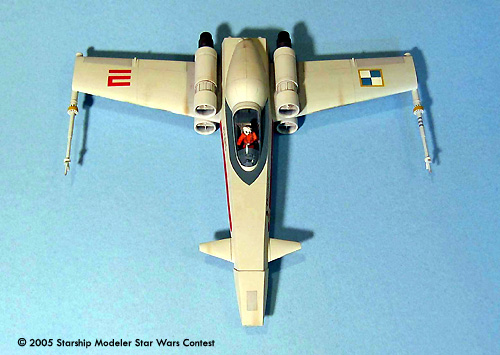
Wings: I started with the wings from an old Hawk 1/48 scale U-2 kit. I sectioned pieces out of an old kit's wings to create a new swept, tapered wing. I filled in and sanded off all the kit details and scribed in new panel lines. I carved large depressions into these pieces near the wing roots to accept the four-engine layout, as well as smaller depressions for the wingtip blasters.
Engines: I built the engines using a series of plastic tubing pieces that "nest" inside of each other. The dark "finned" sections (the front ends of the dark exhaust assemblies) were created by wrapping and gluing .020" solder around the core tubing. The "splitter plates" from the Fine Molds X-wing kit went into the new intakes, and the kit's exhausts were also used.
Finishing
The overall paint and markings are similar to standard Star Wars forms. This starfighter serves in planetary self-defense forces, so I weathered it with pastels, oil washes, and worn leading edges to match its environment and relative level of maintenance.
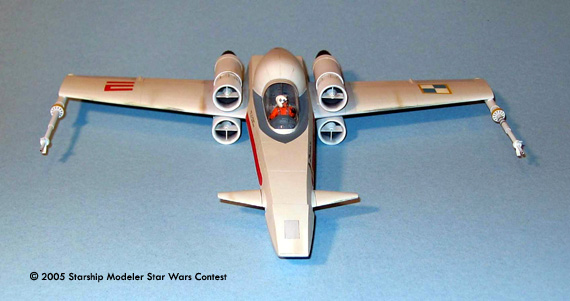
Image: Left side view
Image: Underneath
Image: Top
Image: Fuselage construction
![[Starship Modeler's 11th On-Line Scale Model Contest: Star Wars]](ssm_starwars_contest_banner.jpg)