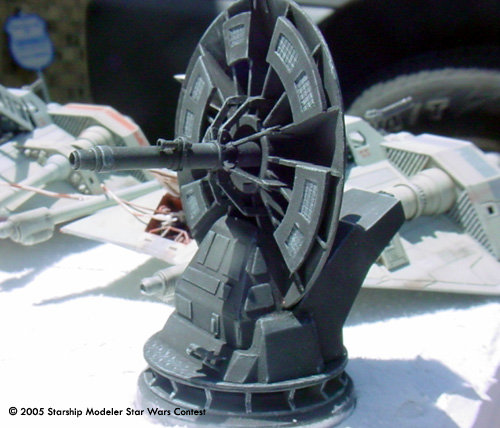
This was actually the part of the diorama I
spent the most time on, and I'm very happy with the way it turned out. It
was painted with Testors enamel flat black, and drybrushed with gunship
grey and light ghost grey. There is an open access panel on the right
side, with a detailed interior, but I couldn't get any of the pictures to
turn out, so I left them out. You'll see it at Wonderfest.
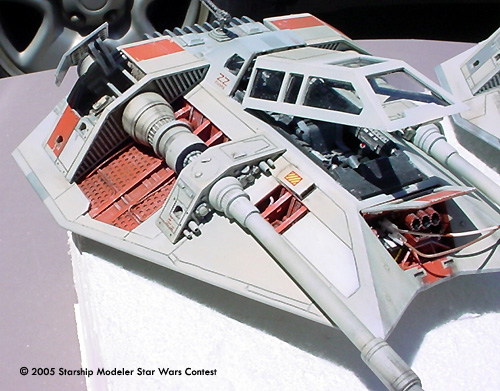
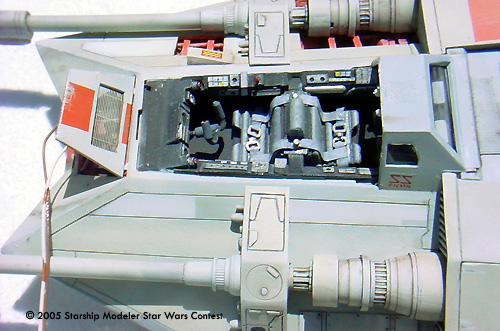
The snowspeeders were both heavily modified, starting with the cockpits.
The kit's instrument panels had the right shape, but the details were all
wrong. I sanded off all the details and replaced them with different
inaccurate detail. At least they're more accurate than the originals. I
resculpted the seats, and added harnesses and buckles. I watched the
battle of Hoth scene over and over again in slo-mo, pausing frequently.
This allowed me to make drawings of the side panels and other interior
details, which I then scratchbuilt. The left side panels and gunner's
station are a lot more accurate than the kit parts, but the right side
panels are still pretty much guess work. Oddly, you never see how the
pilots steer the air speeders. All you can tell is that they are holding
some kind of yoke, below camera level. So I built a generic looking
steering yoke. The interiors were painted and drybrushed with acrylics,
to give them a dusty, well worn feel.
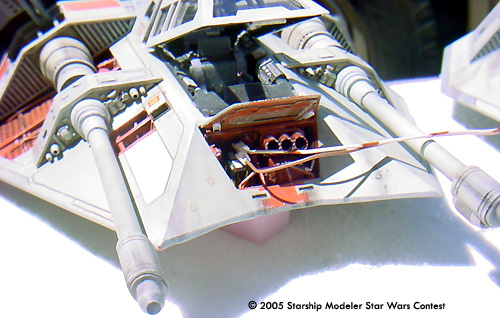
The Lucasfilm Archives book has a picture of one of the hero filming
miniatures with a couple of the panels taken off on the right side. I
chose to replicate this miniature as closely as I could for the broken
down speeder. The guts of the speeder were built from sheet styrene, some
scale perf stock I made, some wire and solder, and little greeblies off
old tank models. I made the support girders from Evergreen stock and
sheet styrene, and a ton of dry-fitting. I also had to find a place for
the "12 volt car batteries", and under the front hood seemed like as good
an idea as any. So I cut away the front panel, and built up a nice
looking interior. I made new hoods from sheet styrene, and the grills are
made from H.O. scale photoetched venetian blinds. The jumper cables are
22 gauge wire, with bits of Evergreen strip stock for the clips.
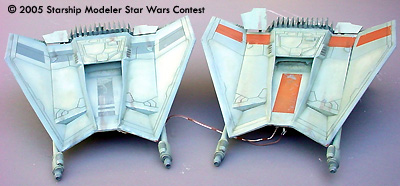
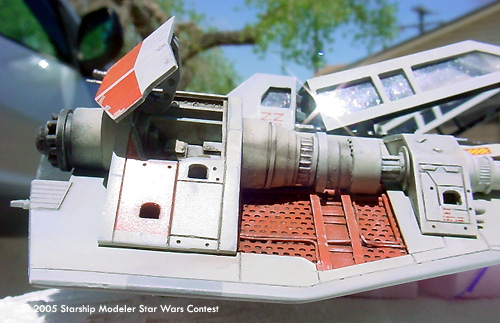
All the panel lines were sanded off and re-scribed to match one of
several different filming miniatures. The step revetments were hollowed
out and boxed in, and holes were drilled into the one open airbrake
armature. The plastic around the open panel areas was too thick, so I cut
the openings too wide, and boxed in around them with .010" sheet styrene.
The guns were detailed with evergreen strip, and the gun barrels were
replaced with aluminum tube. The front panels for the gun placements were
entirely rebuilt. I scratchbuilt the canopy hinges based on drawings from
The Art Of Empire Strikes Back, and glazed the canopies with .010 clear
plastic.
Both models were painted with Model Master enamels, mostly camouflage
grey, with different shades of ghost grey and flat white for various
panels. The heat exchangers were painted with dark anodonic grey and
buffed shiny. The orange stripes and interior panels were painted by
mixing red and yellow Testors until I thought it looked right. I did not
clear coat the model before giving it an oil wash, because I wanted the
oil paint to stain the surface and give it a well worn look. This was a
big risk, and I'm glad it turned out like I'd hoped. Decals were added
from the old kit, the new one didn't have any. Paint scratches and
blaster marks were made by scraping the surface with an X-acto blade, my
fingernail, sandpaper, lifting paint with scotch tape, and drybrushing
with enamels and pastel chalks. A final coat of clear flat lacquer, and
the kits were done.
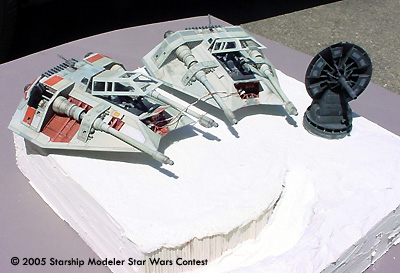
The dio base was made from high density pink insulation foam, coated with
drywall spackle. The walls of the trench were made from used kitchen
matches I've been saving for six months for just this purpose. The
drywall spackle was painted with Krylon white primer while it was still
wet, and Woodland Scenics snow was sprinkled on while the paint was still
wet. The pictures were taken before the dio base had dried, using a Sony
Mavica in direct sunlight. I know you're supposed to use indirect
sunlight, but I wanted to capture the same look that the battle of Hoth
had, a cold, sunny day.
Image: Turbolaser tower
Image: Detail on left side speeder
Image: Battery compartment
Image: Ride side detail
Image: Cockpit
![[Starship Modeler's 11th On-Line Scale Model Contest: Star Wars]](ssm_starwars_contest_banner.jpg)