Realizing that the attacks over the years weren't some random fluke, but a series of systematic attacks against the Earth, the Trust brought in several other governments and made reparations to the USSR in an attempt to form a united front against these alien invaders.
By combining back-engineered technology from the alien spacecrafts with our own advancing technology, when the 5th attack came the Earth was ready. We could no longer rely on the Earth's native defenses, as the aliens had developed immunity to pollen & other attacks. Advances in projectile technology enabled us to penetrate their force shields, knocking their gravity-defying craft from the sky.
Analysis of the downed wreckage provided key technologies that were incorporated into the construction of the Leopard VII and other hover tanks. First was a very powerful energy generator that runs the craft's shields and anti-gravity device. The second was of a working anti-gravity generator.
After the aliens were driven off Earth it was determined that we would have to take the battle to them or forever face invasion threats. Quickly the Leopard VII and it's brethren were developed, largely using existing tank hulls and other craft. When it was found that even after removing much weight from the tanks hulls by using the newly developed Chobham X armor, the scaled down anti-gravity generator was insufficient to both lift & propel the tank, auxiliary jets where added powered by the incredibly compact energy generator. Several submarines & battleships where converted to carriers, tenders, and defensive craft, with huge power generators and massive AG lift systems.
The assault on Mars was ready.
The Fleet arrived in 6 waves. The 1st and 2nd landing groups suffered extreme casualties which was to some extent expected. While the bulk of the attack was targeted at what we believed were Martian installations, the real target was the poles. With the poles taken we could establish a base of operations that would be much easier to operate from than in the equatorial regions. Despite their seemingly superior technology, the Martians were soon defeated.
The Martians fought to the last tentacle, literally to their last man. The Earth Forces made several attempts in the course of the war to negotiate for peace but were always met with more assaults. After their defeat it was discovered why they fought so desperately. They had not originally come from Mars, but somewhere outside our solar system and were defending the remains of the craft that had brought them to Mars some 300 years ago. Believing the Earth to be under imminent attack the Strategic Space Command was formed to deal with this threat, should it ever come to pass.
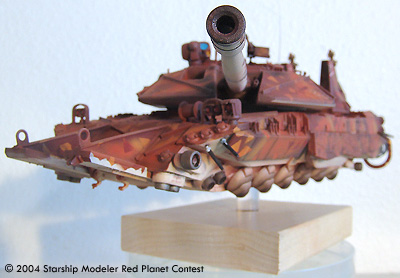
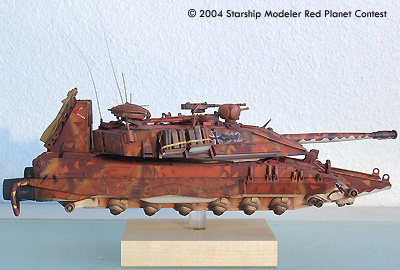
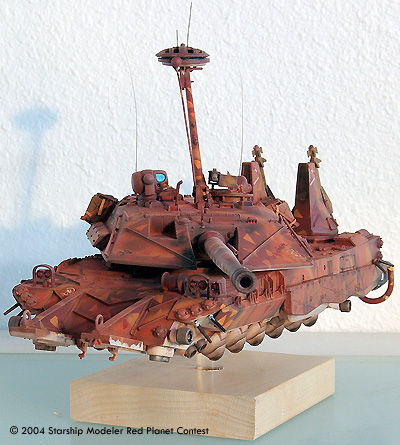
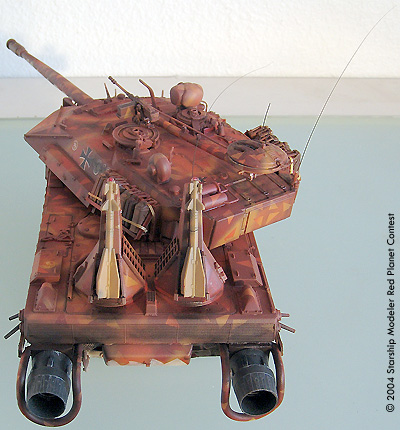
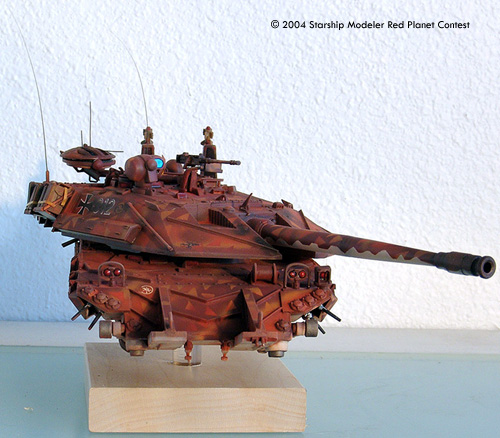
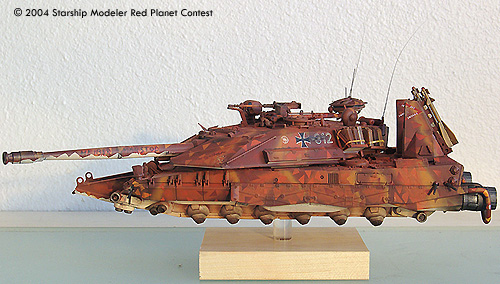
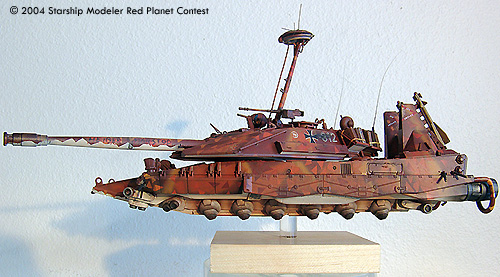
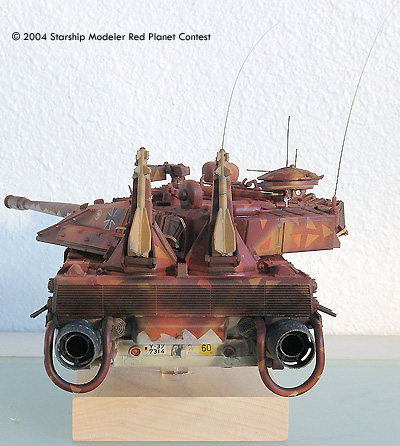
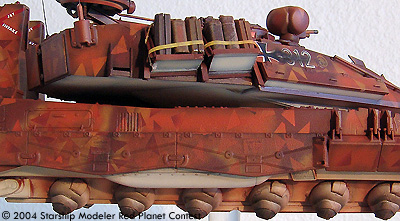
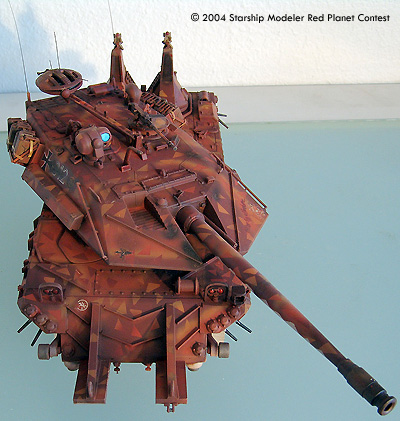
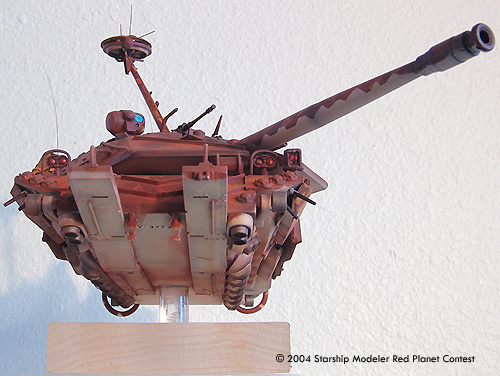
Shown here is a Leopard VII from the Angriff Gruppe 60 soon after its mission near the north pole of Mars. Notable are the extra water cans on the side for extended missions and the retrofitted UDH (Over The Hill) sensor pod. The Leopard VII has a 120mm taper bore main gun firing kGeduhEn (ultra high energy kinetic projectile) rounds with a coaxial mounted 20mm cannon. To the rear are two ground to air/ground to ground missiles that can be guided to target in several ways. A 13mm remote controlled machine gun is mounted over the gunners position and two 20mm gun pods are mounted below the skirts on the side. The Leopard VII can also be mounted with auxiliary wing pods, for additional rockets or cannon.
The Model
This started out as a simple, fun build that ended up taking a month, more cash than expected and a lot more parts. Starting with a Italeri Leopard II tank, I extended the turret front & sides to give it a more sleek appearance. Then I whacked off the wheel mounts and various other detail. The side sponsons & rear air intakes were crafted out of sheet plastic along with the new front nose and ram prow. The sheet plastic I had, what cost money was the "L", "H", & "I" beams to give it that "armored" feeling. The lower exhaust units are from a bunch of 1:200 Macross Zentradi pods. Barrel was turned from aluminum. Used parts from all over, other tanks, aircraft, sci-fi kits, you name it. Even stole some parts out of kits I plan to build, but only because I knew I could get replacements. I used cat whiskers for the whip antenna.
A note on the rear air intakes. They were the first ones I sketched out but the last ones I built. After finishing the first sketch, I did another that I thought looked better. I built that set - but they looked horrid on the tank. So I tried multiple variations, non of which looked right. When I gave up and built off the first sketch, the result was perfect. So sometimes your first impulse is the best.
Next I hit the internet to find "Martian" colors, picking out 4 to use for the paint scheme and adding the light tan for the underbody. All the colors were custom mixed from Tamiya paints.
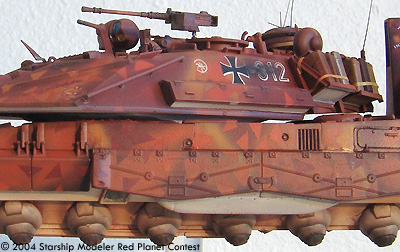
Then came time to paint. I think I pre-shaded almost everything on this model, from hull to turret, from water cans to exhaust nozzles. Sometimes twice, due to the type of camo I wanted. To get the effect I wanted for the hull meant painting it twice; once for the under color, then adding forty ba-jillion triangles and painting it again. And all of it pre-shaded. Nuts? Probably, but it looks cool. Then a gloss coat, decals, wash, matte coat and weathering. Easy. Oh, and don't forget that it was also counter shaded (meaning top is dark, bottom is light) to help deal with the increased contrast of the Martian light.
Luckily everything that broke off during my marathon painting session glued back on without a hitch.
I drilled a hole in the bottom for a 1/2 inch acrylic rod and set it in a maple base provided by a fellow Starship Modeler
Oh, and the name of the tank translates to "Martian Mistress" with "Hot Martian Death" on the barrel...hopefully...anybody speak German?
Image: Front view
Image: Left side
Image: Close-up
Image: Sensor mast raised
Image: Rear view
Image: Right side detail
Image: Top/front
Image: As seen from a foxhole