Starship Modeler's 10th on-line modeling contest: Red Planet

Entries Page
Contest Rules

Home

CEV-Derived Mars Lander Eagle II


by David Hanners


Scale: 1/72

Original design; Scratchbuilt from paper, cardboard, wood and aluminum foil

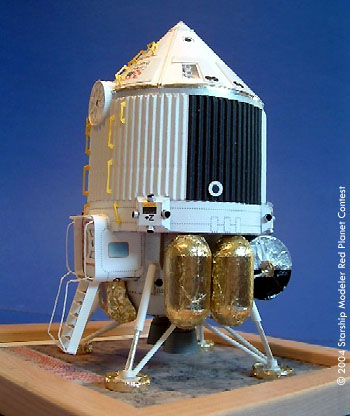
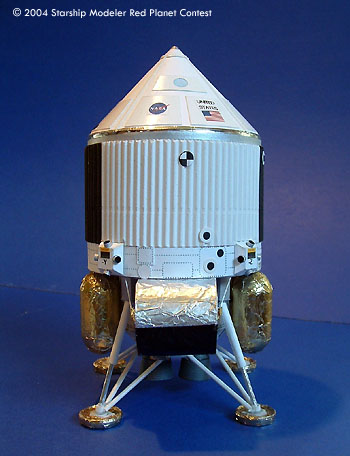
This is an original design of a conceptual manned Mars lander derived from a Crew Exploration Vehicle (CEV). The lander is a component of a larger spacecraft assembled in Earth orbit and then launched to Mars. Upon arrival at Mars, the lander undocks and enters the Martian atmosphere protected by a conical aeroshell, which is then jettisoned. After being slowed by parachutes, the lander fires its two ascent/descent motors to further slow its descent for a soft landing.

After the astronauts' stay on the Martin surface, the ascent/descent motors are again fired to launch the vehicle into orbit (the landing leg structure is detached at launch and left behind on the Martian surface) and then it completes a rendezvous with the orbiting Earth-Return Vehicle.

As built, the model depicts the vehicle in the just-landed "clean" configuration before the deployment of antennas and various surface equipment.

The Model

The model was scratchbuilt from paper, cardboard, wood and aluminum foil. Various kinds of paper were used, including 65-pound white and colored stock, special white and black corrugated paper and silver paper. The body comes in three main sections, from top to bottom:

Command Module -- The CM was made from 65-pound white stock, cut and formed into a cone using dimensions gleaned from an online shroud calculator. Details were added with heavier and lighter paper stock.

Habitation Module -- A section of an empty Morton's Salt container was used for the basic shape. It was covered with black and white corrugated stock, with an upper band of silver paper. The surface exploration hatch was designed on a computer, printed out and cut and folded to shape. The boarding ladder and handrails were cut from heavy stock paper. The Reaction Control System (RCS) housings were designed on computer.

The RCS nozzles are silver paper (colored black on one side) rolled into small tubes and sliced to create individual nozzles.

Propulsion Module -- A model rocket body tube was used for the basic shape, and it was covered with silver paper. A truncated cone (made using the shroud calculator mentioned above) was added to the bottom. Details such as access panels and rivet lines were designed on computer and printed onto the paper. Other details were made from paper of various weights. The vehicle's propellant tanks are wood pieces found at a surplus store and covered with gold-colored aluminum foil from a Cadbury’s chocolate bar. The rocket nozzles are re-sized versions of the motors from the Delta 7 Studio card Gemini-Titan II rocket. Small wood dowels were used for the landing leg outrigger struts. The foot pads were made from small wood disks, paper and foil. The main landing legs are tubes rolled from 65-pound paper.

Various details such as markings, warning placards, access panels and other items were designed on a computer and printed out either directly onto the paper used to make the body, or they were printed out onto lightweight paper, cut out and added to the model. The U.S. flag and NASA "meatball" were cut-and-pasted from online sources.

Aluminum foil (from the Cadbury’s bar) was used on various parts of the model to represent insulation blankets. Also, small boxes were made from paper and covered with foil to represent external equipment boxes. Bare Metal Foil was used for the metallic sections of the landing legs and for the insulation seal between the CM and HM.

Printed material was processed on an HP Photosmart 1115 printer. Lineco Neutral pH Adhesive was used for construction. The foil was attached with Microscale Micro Metal Foil Adhesive and Super Jet medium viscosity cyanoacrylate glue.

For the base, I found a map of Mars online, printed it out, cut it to size and glued it to a section of foam-core board. The board was then glued into a picture frame.

The model is approximately 7” (178mm) tall.

Image: Back

Image: Side

Image: Above and to the side


Go back up | Starship Modeler Home | Site Map | Feedback

This page was last updated 7 July 2004