Artificial gravity generators and conduction plates
Installed in the floors and ceilings, creating safe electro-magnetic fields to provide artificial gravity and inertial dampening.
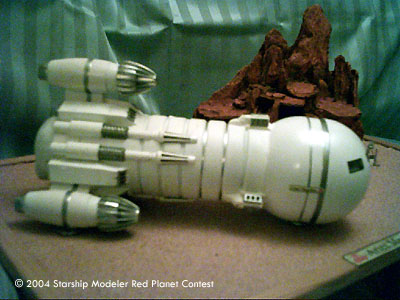
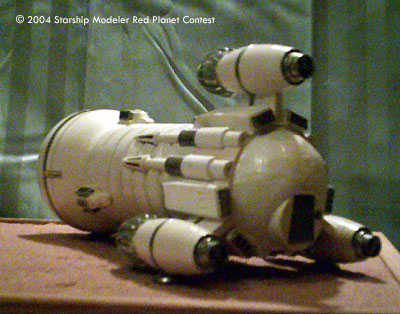
Ion drive engines with integrated “ram scoops”
These collect space borne gases, which are fed into a smaller protostar reactor within each engine pod, and converted into ionised plasma to produce forward thrust.
Neutrino field generators
These provide a force field to protect against space radiation and micro-meteors. At higher power settings, it also provides the ability to access “etherspace” for limited periods of time, by causing the craft to phase-out of our normal space-time dimension (as discovered in the Philadelphia Experiment, based upon Einstein's Unified Field Theory). This allows the ship to travel through etherspace in “short” jumps, reducing the travelling time to Mars to just over one month.
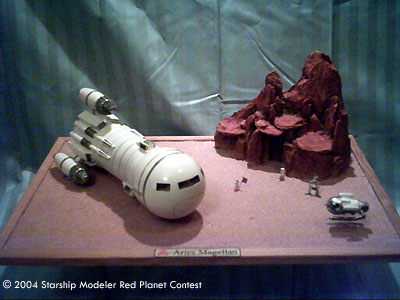
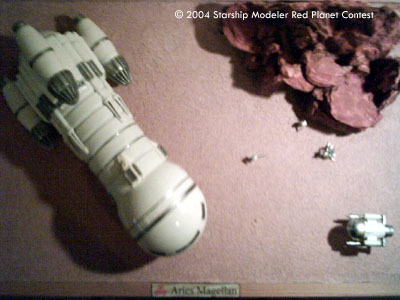
The diorama shows the forty sixth day of the mission and the third day on the Mars surface. The Aries Magellan had landed at the designated co-ordinates following an uneventful journey and routine orbit of Mars. Everything was going to plan.
The “Skimmer”, a small support craft carried by the Magellan, ventured out on its second survey mission and discovered a rock formation that appears to have been created artificially. Surveying equipment was set-up and initial scans confirm that the rocks seem to have been shaped and placed into position. The implications were huge! Intelligent life had already visited Mars, or had maybe even lived there!
The Magellan relocated to the new site, and more detailed investigations could begin.
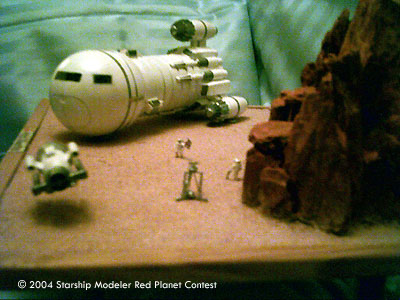
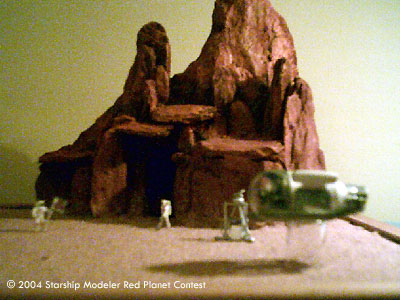
We see one astronaut carrying out a survey at the mouth of the cave, whilst another gets ready to plant the Aries Group flag, to claim the site. A third astronaut is in the Skimmer, taking off to perform an aerial scan. The final crewmember is still on-board the Magellan, co-ordinating the surveys, and analysing the data.
The Diorama
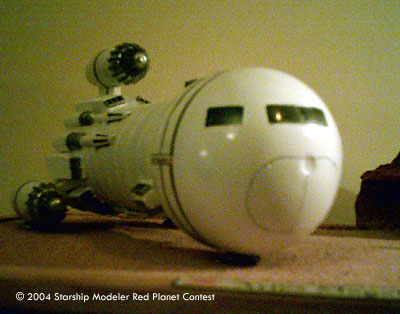
The models and scenario above came from a chapter in my novel (I will get around to finishing it sometime). There are many influences for the design of the Magellan, but I think the main source was “The Discovery”, from “2001: A Space Odyssey”.
An assortment of materials was used to create the Magellan, including:
a large Thunderbird 3 toy; a large “ball” capsule from a vending machine; a cordial bottle; six Concorde engines; the gun barrels from “Star Wars STAP and Battle Droid” models and three plug-in air-freshener bottle tops.
Various other bits from the “Gubbings Box”, were used, including:
three small Thunderbird 4s; eighteen engine gratings from Perry Rhodan “Blues Ship” models; three intakes from a Star Wars X-Wing Fighter and three coat buttons for the landing feet. There is even a gravy granules carton in there, to give the body some internal support.
The design for the Skimmer was based on those mini-subs, used for surveys, etc. There is even a hint of the insect-like shuttle used by the crew of the Lexx in the design of the cockpit module.
To create the Skimmer, the bottom section of a small Imai Thunderbird 3 model was used, together with half of a small vending machine capsule, the fourth X-Wing intake and six small Concorde wheels. The “arms” from a new-shape Thunderbird 4 toy were used to create the landing skids. Parts of the stickers from the large Thunderbird 3 were used as “cargo hatch doors”, on each side of the Skimmer.
I wanted to give the main vehicle some interior detail. The vending machine “ball capsule”, half of which was made of clear plastic, gave me the opportunity to create “windows”, and a removable front, to show off the interior.
The interior surfaces (the walls, ceilings and floors) were designed using PowerPoint, printed and glued to cardboard, then given a “wash” with PVA glue, to strengthen them. They had to be designed to fit snugly within the ball capsule, requiring some careful calculations.
Display screens and control panels were created in a similar way, taking larger screen graphics and pictures from the web, and then shrinking to the correct proportion before printing. The fire extinguishers and door control panels were cut out from the stickers taken from the large Thunderbird 3 toy. The chairs on the Magellan's bridge were also designed using PowerPoint, printed and shaped, and glued to gubbings (which formed the seat bases).
The Skimmer cockpit also has some detail in the interior, with a printed back panel and control panels, and seats and a central console taken from a 1:72 scale military helicopter model.
Given the different construction materials being used, it all went together quite well.
However, during the build it became clear that the “hanger bay” for the Skimmer would be too small to accommodate it realistically. I was forced to extend the middle of the sphere, using a slice from a cola bottle and some card (for additional strength). The interior of the hanger bay had to be recalculated and redrawn, to take into account the extra length that was created.
The models were painted using white gloss spray paint, for a clean, basic utilitarian look (note that the neutrino field would protect the ship from “weathering” and the heat of atmospheric entry). The hanger bay doors and bridge windows were masked-off during spraying. The masking for the hanger bay doors was removed for the final coats, creating an indented area. Silver model paint was used for various details. Name plates, containing the Aries Group logo, were designed using PowerPoint, printed and glued to the outside of the command pod of the Magellan.
The base was created using a framed cork message board, built up using kitchen towel sheets, ripped into pieces and glued down using PVA glue. It was then painted using textured masonry paint. The rock formation is an aquarium ornament, with bark “chippings” used to plug some of the holes (painted to match the rest of the rock).
The survey device on the planet surface was created using three undercarriage supports from the Concorde models, with some other gubbings for detail (all painted silver and white), and a printed display panel.
The standing astronauts were from a micro-machines space set - the Aries Group flag was again created using PowerPoint and printed. The astronaut in the Skimmer was from a Zoids toy (she was painted white and silver), and the fourth crewmember is a model railway figure.
I have enjoyed the challenge of building this diorama, using the mismatched construction materials and calculating the measurements for the interiors. It is great to see a small part of my novel being brought to life, and being able to share a scene that had previously only existed in my head.
Image: Crew
Image: Magellan, front/right view
Image: Left/rear
Image: Looking down